


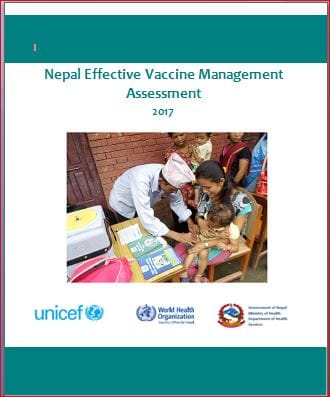
One of the fundamental pillars for national immunization program is the immunization supply chain management and Effective Vaccine Management (EVM). One of the basic requirements for the country to identify interventions to improve the effective vaccine management system is to conduct periodic EVM assessment using standard tools. Based on the EVM assessment, an improvement plan is developed which would be the milestone indicators to assess the investment made to strengthen the EVM. In Nepal, EVM assessment was carried out from March to May 2017. The EVM assessment was conducted in four tiers. First tier was the national vaccine store (CVS), the second was the sub-national vaccine store (RMS), the third was lowest distribution center (DVS) and the fourth one was service points (Health facility).
The assessment was conducted in all sub-national vaccine store, randomly selected lowest distribution center and service points.
Sampling process was followed by data collection. For the data collection, independent enumerators were selected who had professional experience on surveys and educational qualification of health background (pharmacy, nursing and public health with minimum qualification of certificate level). Seven day intensive training sessions was provided to train the enumerators with EVM Assessment Checklist (questionnaire) generated from EVM Assessment Tool (version 1.1.0). To ensure quality of assessment, a quality assurance team was formed from center (CHD, LMD), region (RMS, RHD), and UNICEF.
The EVM assessment identified the key strengths and weaknesses in nine different areas of vaccine management at each of four levels of the vaccine supply chain, and make recommendations to address any weaknesses. The four supply chain levels were:
PR | Primary level |
SN | Sub-national level |
LD | Lowest distribution level |
SP | Service point level |
The nine areas (criteria) of vaccine management are:
E1 | Vaccine & commodity arrival procedures |
E2 | Vaccine storage temperatures |
E3 | Cold & dry storage capacity |
E4 | Buildings, CC equipment & transport |
E5 | Maintenance |
E6 | Stock management |
E7 | Effective distribution |
E8 | Good vaccine management practices |
E9 | Information systems and supportive management functions |
A systematic sample of vaccine storage facilities was surveyed and the data was collated and assessed by supply chain level.
Out of the 9 categories, 4 categories namely -vaccine & commodity arrival procedures; cold and dry storage capacity; buildings, cold chain equipment and transport and good vaccine management practices has achieved more than 80%. Among supply chain level, the EVM scores in 7 out of 9 categories in service point. The overall EVM score for 2017 is 82%.
There has been improvement in the EVM scores in 2017 from that of EVM assessment 2014. Different intervention implemented 2015-17 has been attributed to improvement in the scores. Further improvement in the scores will require significant investment in effective distribution, maintenance of the temperature in the cold chain devices and increased attention for cold chain system in the service points.
Health Education Agriculture and Logistics (HEAL) Group, based in Nepal and registered as a 501(c)(3) nonprofit in the U.S., has been a catalyst for positive change since 2014. Focusing on health, education, agriculture, and logistics, we combine local insights with innovative solutions to serve underserved and marginalized communities.
Stay updated with our latest news and initiatives! Subscribe now to join our mission and make a difference.
Leave a Reply