

Nepal has achieved significant outcomes on child health, significantly reducing preventable childhood deaths in the last few decades and successfully achieving the Millennium Development Goals (MDGs). As per The MDG: Final Status Report 2000-2015 (National Planning Commission, Government of Nepal, 2016), under five mortality rate (U5MR) reduced to 38 per 1000 live births (LB) in 2014 from 162 in 1990 and 91 in 2000.
Similarly, infant mortality rate (IMR) reduced to 33 per 1000 LB in 2014 from 108 in 1990 and 64 in 2000. A major contributor to this success is the national immunization program, a priority one program of the Government of Nepal (GoN), which currently provides free vaccinations to over 630,000 children annually against eleven types of vaccine preventable diseases (Child Health Division / MOHP, Ministry of Federal Affairs and Local Development and WHO, 2014). However, the coverage of all basic vaccinations in the five-year period preceding the survey has shown a decrease, from 87% in 2011 to 78% in 2016 (NDHS 2016), and still 1% children are not receiving any vaccination at all.
Nepal has committed to the post-MDG Sustainable Development Goals (SDG) 2030 and has developed strategies to ‘leave no one behind’ in reaching all children with full range of immunization services as per the national legislative framework and policies related to child health and immunization. Full Immunization Declaration of rural and urban municipalities and districts, a novel initiative of GoN started in 2012 and scaled up recently, is one such strategy. The concept of full immunization declaration relates to complete vaccination of all children from zero to 15 months of age according to the national schedule of immunization. The second Comprehensive Multi-Year Plan (CMYP) 2017-2021 for Immunization aims at achieving 100 percent full immunization coverage by 2021. As of mid-July 2018, 55 districts have been declared as full immunization district.
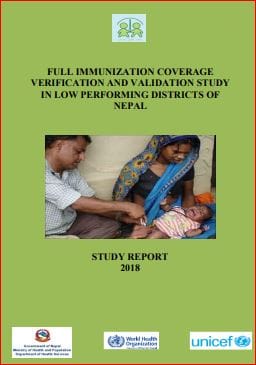
The objective of this study was to verify and validate the status of full immunization coverage in low performing districts1 through population-based estimates of the coverage of fully vaccinated children aged 12-23 months and key stakeholder consultations.
Specific objectives:
The specific objectives of the study were:
Health Education Agriculture and Logistics (HEAL) Group, based in Nepal and registered as a 501(c)(3) nonprofit in the U.S., has been a catalyst for positive change since 2014. Focusing on health, education, agriculture, and logistics, we combine local insights with innovative solutions to serve underserved and marginalized communities.
Stay updated with our latest news and initiatives! Subscribe now to join our mission and make a difference.
Leave a Reply